How can we help you?

Council Tax

We understand that dealing with Council Tax after someone has died can be difficult. This page explains what happens to Council Tax in different circumstances and when an exemption or discount may apply.

Tell us as soon as possible

Please let us know as soon as possible if the person responsible for paying Council Tax has died.

If you are registering the death, you can use the Tell Us Once service. This service shares the person's details with us automatically, so you do not need to contact us separately.

If you are unable to use the Tell us Once service, you can let us know by:

  • This email address is being protected from spambots. You need JavaScript enabled to view it.
  • Booking an appointment to speak to one of our advisors
  • Calling 03004 560 560 between 9:00am and 12:45pm

When you contact us, we will need the following details:

  • the name of the person who has died
  • the Council Tax account number (if known)
  • the property address
  • the date of death
  • details of anyone who still lives at the property
  • the name and contact details of the executor or person dealing with the estate
  • if the deceased was not the owner, the name and address of the property owner or landlord (if known).

Depending on your circumstances, we may ask for additional information, such as probate or letters of administration, once they have been granted.

What happens to Council Tax?

The amount of Council Tax due depends on whether anyone still lives at the property and who owns it.

If someone still lives in the property

If someone continues to live in the property as their sole or main residence after the death, a Council Tax charge will normally apply. The Council Tax account will be updated to reflect the new circumstances, and any discounts or reductions you may be entitled to will then be considered.

In these circumstances:

  • the Council Tax account will be transferred to the remaining liable person, where appropriate
  • if only one adult remains liable, they may qualify for a 25% Single Person Discount (SPD) - Apply for an SPD.
  • if two or more liable adults remain, the full Council Tax charge will continue to apply.

If the remaining occupants are on a low or limited income, they may also be eligible for Council Tax Support to help reduce the Council Tax bill.

If the property is now empty

If nobody continues to live in the property following the death, what happens next depends on whether the deceased owned or rented the property.

The deceased was the sole owner

If a property becomes unoccupied because the person liable for Council Tax has died, it may qualify for a Class F exemption. Where applicable, this provides a 100% Council Tax relief while the qualifying conditions continue to be met.

The exemption applies where:

  • the deceased was the sole person liable for Council Tax
  • the property is unoccupied following their death
  • the property remains part of the deceased's estate.

The exemption normally applies:

  • from the date of death until probate (or letters of administration) is granted; and
  • for up to six months after probate or letters of administration is granted, provided the property remains unoccupied and ownership has not changed.

The exemption will end earlier if:

  • someone moves into the property
  • the property is sold or transferred to a new owner
  • the property no longer forms part of the deceased's estate.

The deceased lived alone but rented the property

If the property becomes empty after the tenant dies, a Class F exemption may still apply whilst the estate remains liable to pay the rent.

Once the tenancy ends or another person becomes liable for Council Tax, the exemption will end.

If the deceased did not own the property

A Class F exemption does not apply because the person living in the property has died.

If another person or organisation owned the property at the date of death (for example, a family member, a trust, a housing association or another owner), that owner may become liable for Council Tax once the occupier has died.

As there is still a living liable person, the property does not qualify for a Class F exemption and a relevant charge will be applicable immediately.

Examples include:

  • a property previously transferred into the name of a son or daughter
  • a property owned by trustees
  • jointly owned properties where the surviving owner remains liable.

If the property was jointly owned

If the deceased jointly owned the property with another person who is still alive, the surviving owner usually becomes responsible for Council Tax immediately.

If they continue to live at the property and are now the only adult resident, they may qualify for a 25% Single Person Discount. Otherwise, the full Council Tax charge will normally be payable.

A Class F exemption does not apply because there is still a living liable owner.

If family members are clearing the property

If family members visit the property to clear belongings or prepare it for sale, this does not count as occupation for Council Tax purposes.

Provided nobody is living there and the qualifying conditions continue to be met, a Class F exemption can still apply.

What happens after probate?

If a Class F exemption applies, it will continue until probate (or letters of administration) has been granted.

Once probate has been granted, the exemption can continue for up to six months, provided that:

  • the property remains unoccupied
  • ownership has not changed through sale or transfer
  • the property remains part of the deceased's estate.

After the exemption ends, Council Tax will become payable. The person responsible for paying the Council Tax will depend on the circumstances, for example the executor(s), personal representative(s) or the new owner could be liable.

Empty property premiums

If the property remains unoccupied after the Class F exemption has ended, an empty property premium may apply, depending on how long the property has been empty and whether it is furnished.

Where applicable, the premium is an additional 100% of the full Council Tax charge, meaning a total charge of 200% becomes payable.

If the property remains substantially furnished after probate has been granted, the full Council Tax charge will become payable six months after the grant of probate (provided the property remains unoccupied and ownership has not changed). However, the property will be protected from the empty property premium for 12 months from the date probate (or letters of administration) is granted.

If furniture is removed from the property during this 12-month period, it is important that you tell us the date this happened. This is because the property will be treated as empty and unfurnished from the date the furniture was removed, and this date is used to determine when an empty property premium may become applicable.

If a property remains empty and unfurnished for 12 months or more, an empty property premium will normally apply. However, where the property formed part of a deceased person's estate, the legislation provides a 12 month period from the date probate (or letters of administration) is granted during which an empty property premium will not be charged, provided the property remains unoccupied.

Please let us know as soon as possible when these events occur to ensure we can bill correctly:

  • probate or letters of administration has been granted
  • the property has been sold or transferred
  • someone moves into the property
  • furniture has been removed from the property.
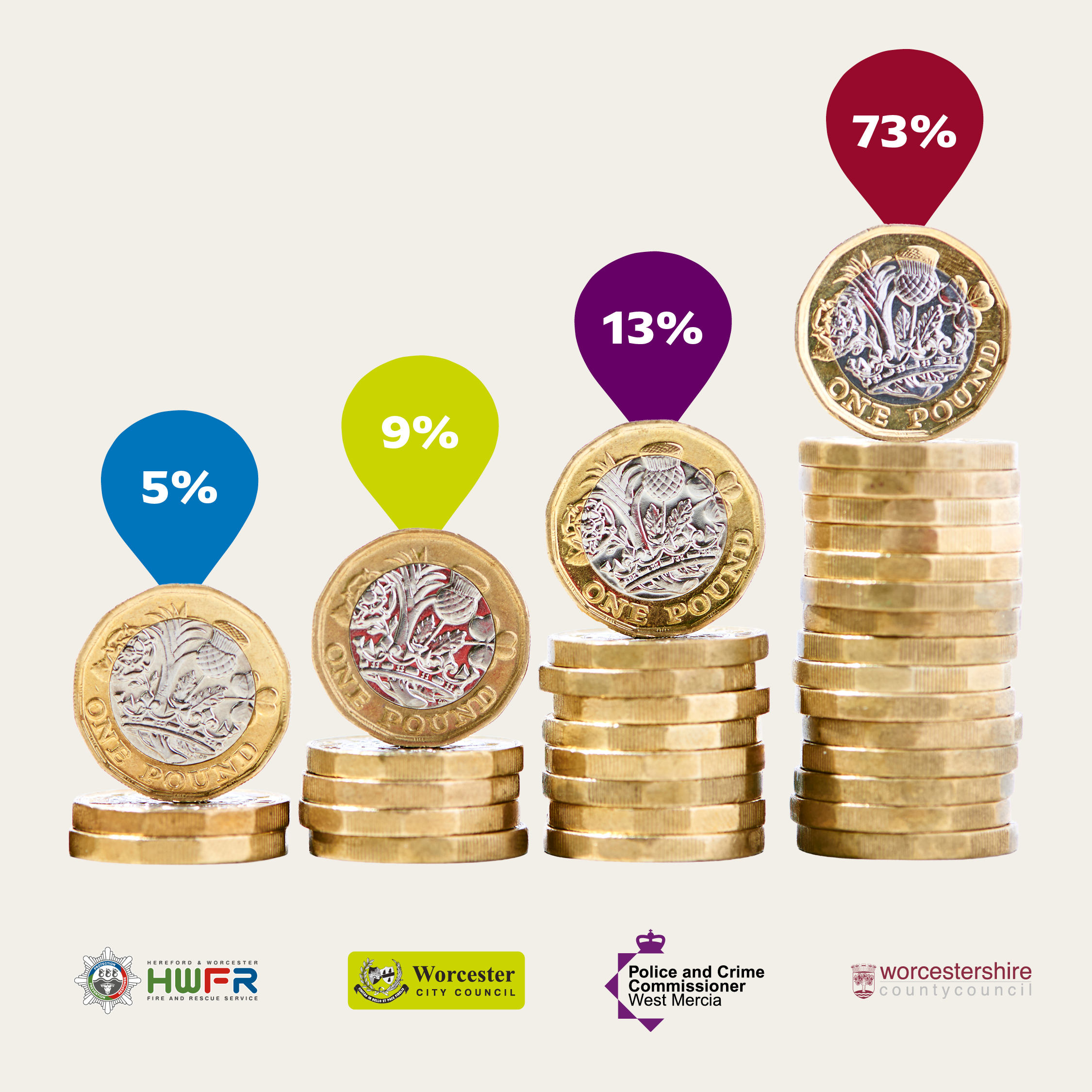
Worcester City Council collects the Council Tax on behalf of Worcestershire County Council, the Office of the Police and Crime Commissioner for West Mercia, Hereford & Worcester Fire and Rescue Authority and, depending on where you live, your local parish council. The total amount is then split to provide the services that are part of your everyday life.

A graphic showing how Council Tax income is divided in Worcester in 2026-27: 5% for Hereford & Worcester Fire & Rescue; 9% for Worcester City Council: 13% for the West Mercia Police & Crime Commissioner; 73% for Worcestershire County Council.

This year, the majority of Band D households in Worcester will pay £2,400.53 to their local authorities - that’s £46.16 a week.

 During 2026-27 Worcester City Council will spend £28.86 million providing essential services to you. Our costs are increasing in line with inflation so this year our element of your Council Tax bill will rise by around 1.8p per day in order to help us protect your services.

Get your Council Tax bill the easy way - sign up for e-billing

Our services to you

Your Council Tax bill helps Worcester City Council to provide you with vital services.

Waste & recycling

Heritage & design (conservation, trees, urban design and archaeology)

Tourism

Car parks

Housing

Emergency planning

Parking enforcement

Leisure & sports development

Economic development & business support

Street cleansing

Sports centres

Trade waste collections

Public toilets

Museums & arts

Licensing & environmental health

Parks & open spaces

Community safety

Building control

Allotments

Community development

Council Tax Support & welfare assistance

Cemeteries & the crematorium

CCTV

Elections

Planning & enforcement

Play areas

Property & asset management

Improving your city and supporting you

Worcester City Council is investing in our city during 2026-27, helping to make it an even better place to live, work and play.

Our Play Plan will see play areas across Worcester improved under our programme of work to meet the needs of all children and young people. Find out more about the Worcester Play Plan

Our investment in Scala Worcester will see the new arts and entertainment centre for everyone in Angel Place and Angel Street open later in 2026. Find out more about Scala Worcester.

We will complete the refurbishment of Worcester Crematorium, improving the facilities and enabling it to meet the latest environmental standards with the addition of electric cremators. Find out more about the refurbishment of Worcester Crematorium.

We will reduce pollution in our city's air and reduce our carbon emissions by moving more than 40 of our lorries, vans and other vehicles from diesel fuel to hydrotreated vegetable oil (HVO). Find out more about how we are making our vehicle fleet more environmentally friendly.

Stay up to date - sign up for our newsletter

How much will you pay for City Council services?*

Valuation Bands Worcester (outside of parishes) Worcester plus Warndon Parish Council Worcester plus St. Peter’s Parish Council 
A £150.67 £171.52 £165.94
B £175.79 £200.12 £193.60
C £200.90 £228.70 £221.26
D £226.01 £257.29 £248.91
E £276.23 £314.46 £304.22
F £326.46 £371.64 £359.54
G £376.68 £428.81 £414.85
H £452.02 £514.58 £497.82

*excludes any discounts, benefits or relief

The City Council’s share of the total Band D Council Tax is £226.01; this is a £6.56 rise on the previous year, but the increase is lower for the majority of city households.

Your Council Tax bill also includes charges for:

How to pay your Council Tax

Direct Debit - The simplest and most convenient way to pay is by monthly direct debit on your choice of four payment dates. Set up a Direct Debit now.

Debit or credit card online

Over the phone - call 0330 088 0680, 24 hours a day, 7 days a week

Paypoint - Payment by cash only at your local PayPoint store. You’ll need the barcode on your Council Tax bill for reference. No charge for payments; £200 limit per transaction.

Difficulty in paying?

Please contact us on 03004 560560 so we can work out a payment plan that suits us both.

This page contains information relating to the local authority's recovery procedure. If you are experiencing financial difficulties or changes to your circumstances please contact us without delay.

Payment Plan

Worcester City Council has partnered with Payment Plan to offer residents an easier way to pay money owed to the Council.

With Payment Plan you can choose how much you pay, how often and when, so you can manage your payments in line with your other financial outgoings.

If you receive an email / text from Payment Plan on behalf of the Council, please follow the instructions and set up your plan with them.

Please note – all money owed remains a debt to the Council not Payment Plan.

For more information, please call us on 03004 560560.

Go to Payment Plan

Council Tax Arrears

Can we reduce your bill?

If you're in receipt of DWP benefits and not claiming Council Tax Support, visit our Council Tax page.

Check if you are entitled to any Council Tax discounts or exemptions by visiting our discounts and exemption page.

Can we maximise your income? Visit the entitled to website or gov.uk for further information. 

Sign up to Open Portal where you can see your account and current bill status set up to pay via direct debit, make an application for benefits and more.

If you’re currently experiencing financial hardship you may wish to contact one of the following non-profit/non-judgemental organisations who may be able to provide free confidential and impartial advice, they may discuss the debt respite scheme (breathing space). 

Financial Statement Form

If you’re currently in arrears or financial difficulty please complete our financial statement form.

What happens if you do not pay your Council tax?

Reminder Notice

If you do not pay as per your billing date you will receive a reminder notice advising you must bring your account up to date within 14 days. If you pay within the 14 day period and fall behind again you will receive a second reminder notice. A maximum of 2 reminder notices will be issued within the financial year.

Final Notice

If you don’t pay within 14 days of the reminder a final notice will be issued losing your rights to pay by instalments and your full charge for the year must be paid immediately.

Court Summons

If the account is not paid as per the final notice a Court Summons will be issued and you will incur court costs at this stage.

What happens if you receive a Court Summons?

If you are unable to pay the balance in full you will be offered a special payment arrangement within your Summons, if you are unable to pay this further recovery action may be taken.

You should complete a financial circumstances form on receipt of the Summons to enable us to further review your circumstances.

Summons for non-payment of Council Tax - Frequently asked questions

Why have I been summonsed?

Because the Council has not received the amounts that you were asked to pay on the bill, reminder and final notice that were sent to you. 

What if I don’t agree that I owe the amount shown on the summons?

If you believe you are not liable for the amount shown on the summons or that the amount shown is incorrect, you must contact the Council as soon as possible before the date of the Court. 

If it is possible to resolve any disagreement before the Court hearing this will save time and inconvenience for both you and the Court.

What happens if I pay the outstanding amount in full before the date I am due to appear in Court?

The Court proceedings will be stopped if you pay in full, including the summons costs, and the Council receives your payment before the date of the Court.

If the costs are not paid, the Council will still apply for a Liability Order for any balance outstanding including costs. The summons will not be withdrawn if you only make part payment or payment without costs.

What should I do if I cannot afford to pay in full?

If you cannot pay in full now, you will have been provided a payment arrangement with this summons which will clear the balance within the financial year, if you are unable to make payments as per this arrangement you should complete the Financial Statement form which can be found on the Council’s website as soon as possible.

The Court hearing will still take place and the Council will apply for a Liability Order unless the balance is paid in full. Costs will still be incurred and any payment arrangement will be for the full amount including all costs.  Failure to pay will result in further action being taken.

Do I have to attend Court on the date shown?

No. You are only required to attend court if you wish to dispute the granting of the Liability Order and believe you have a valid defence in law to do so. 

You have a legal right to attend but the court will not consider any proposals for payment.  The purpose of the hearing is to consider the actual liability for payment of the Council Tax and not your ability to pay.  If you do attend the hearing, please bring the summons with you.

What will happen at the Magistrate’s Court?

If the magistrate decides that the Council Tax has been legally demanded and that you have not paid the amount due a Liability Order will be granted.

What is a Liability Order?

A Liability Order is a legal document which provides the Council with a number of options to collect your outstanding Council Tax, including authority to:

  • Ask for details of your financial circumstances which, if not provided could result in you being fined.
  • Deduct the amount payable from your earnings.
  • Deduct the amount payable from your Income Support, Job Seekers Allowance or Employment Support Allowance, Universal Credit.
  • Place collection in the hands of the Council’s Civil Enforcement Agents. Enforcement Agents are legally entitled to remove and sell your goods at public auction.  You will also have to pay any fees they have incurred.
  • Apply to the County Court for a charging order on your property that enables the Council to force its sale or reclaim your Council Tax from the proceeds of any future sale, providing sufficient funds are available.  Please note that a debt can only be charged to a property if you own the property.

There are other options available to the Council, including commencing bankruptcy or liquidation proceedings and ultimately, you could be sent to prison.

What is a Valid Defence?

A liability order will not be granted if there is a valid defence against the request such as;

  • The Council Tax/Business Rates has not been probably set
  • The property is not entered in the Valuation List
  • The total amount of the summons has been paid in full and a receipt is available and evidence provided
  • Bills and reminders have not been sent (this is not the same as not being received)
  • You are exempt from payment of Council Tax/Business Rates and can provide evidence
  • The bill you have received is incorrect as you are not the person who is liable to pay Council Tax/Business Rates
  • The application for a liability order was made more than six years after the first demand was issued
  • Bankruptcy, winding up proceedings have commenced or an Administration Order/Debt Relief Order has been made and the Council Tax/Business Rates debt is included.

I’m on a low income and not receiving Council Tax Support.  What should I do?

If you are on a low income you may be entitled to a reduction in the amount of Council Tax you have to pay.  Please contact us immediately to discuss this. For further information about how to check to see you are receiving all the benefits you are entitled to and how to claim benefit visit our website. In the meantime you need to make arrangements to start paying your Council Tax whilst any benefit award is being considered.   

Who can I turn to for independent advice?

You can contact the following not-for-profit organisations for free, confidential and impartial debt advice or for details of where to get such advice in your area:

Citizens Advice

For advice and information on benefits, debt and other topics, visit your local Citizens Advice

(address in the phone book) or go to www.adviceguide.org.uk or www.citizensadvice.org.uk

National Debtline

Phone 0808 808 4000 or visit www.nationaldebtline.co.uk for debt advice and information.

StepChange Debt Charity

For debt advice throughout the UK phone 0800 138 1111 or visit www.stepchange.org

Money Advice Service

For free, unbiased and easy-to-access money tools, information and advice, visit www.moneyadviceservice.org.uk or phone 0300 500 5000 to speak to a Money Adviser

AdviceUK

Member centres offer debt advice including specialist advice for minority communities and people with disabilities. For further information phone 0300 777 0107  

Attachment of earnings/benefits

The local authority may consider issuing an attachment of earnings order due to non-payment of Council Tax, a maximum of 2 attachment of earnings orders can be issued to a debtor which will take deductions directly from your earnings. This will be calculated at a percentage dependant on your earnings, for more information on the values please use our online calculator.

{module title="Calculator"}

If you are in receipt of Universal Credit, Job Seekers Allowance, Income Support, Employment Support Allowance or Pension Credits we may consider issuing an attachment of benefits order to the Departments of Work and Pensions for deductions to be taken directly from your ongoing benefit award.

You will receive a copy of the Court Order served to your employer, please note we do not have to gain your permission to proceed with this action.

Employers

For further information in regards to the administration of an attachment of earnings order please see our Guide for Employers.

Attachment of earnings acknowledgement form

If you’re an employer and have received an attachment of earnings please View and complete the attachment of earning acknowledgment form.

Enforcement Agents

Enforcement agents are:

Dukes Bailiffs Limited - View Dukes Bailiffs Limited website
Tel: 01785 825500
Email: iThis email address is being protected from spambots. You need JavaScript enabled to view it.

Marston Holdings Enforcement Agents - view Marston Holdings website
Tel: 03333201822
Email: This email address is being protected from spambots. You need JavaScript enabled to view it.

We are unable to discuss repayment terms once your account has been passed to the Enforcement Agents therefore you should contact them directly.

Enforcement Agent Fees:

  • Stage 1 - Compliance Stage - £79.00
  • Stage 2 - Enforcement Stage - £247.00 (debts over £1900, will be charged an additional 7.5%)
  • Stage 3 - Sale or Disposal at Auction - £116 (debts over £1,900 will be charged an additional 7.5%)

What happens if the Enforcement Agents are unable to collect your debt?

We will request HMRC provides your employer's name and your earnings which would enable an attachment of earnings order to be served. If you’re not employed they will provide us information regarding your benefits in payment. 

Charging Order, Bankruptcy or Committal

If attempts to recover outstanding tax via the above options the local authority will consider applying for a charging order against your property or taking bankruptcy proceedings against you.

Alternatively, the local authority will consider requesting the Magistrates Court to issue a summons for you to attend a committal hearing, which could result in you being sent to prison for unpaid tax.

Freeman of the Land

The ‘Freeman of the Land’ movement and groups of this nature believe Council Tax is a contract and requires a signature in order for them to be legally held liable for payment of Council Tax.

This is incorrect, Council Tax is not contractual and is billed in accordance with legislation linked below and does not require your consent, there are no legal basis in withholding payments in relation to this argument as noted with the Manchester Magistrates’ court vs McKenzie (2015) case.

It is important to note

  • Council Tax liability is not optional
  • Refusal to pay quoting ‘Freeman of the Land’ will not exempt your liability
  • If you refuse to pay as per your bill further recovery action will be taken

Further information can be found below:


Pay my Council TaxHow much is my Council Tax?Council Tax self serviceMoving houseContact usCouncil Tax discounts and premiumsCouncil Tax SupportExempt dwellingsWhat if I can't pay?What if I don't pay?Council Tax when someone passes away

What is Council Tax?

Council Tax is a local tax set by your local councils.

It helps to pay for local services such as schools, libraries, refuse collection and sports centres which are provided by Worcester City Council, Worcestershire County Council, West Mercia Police and Hereford & Worcester Fire Authority.

If you live in the parish of Warndon or St Peters you will also pay a small amount for parish council services.

You pay your Council Tax to the City Council and we send the county, police or parish the amounts they have asked for.

Find out more about what your Council Tax pays for.

The Secretary of State made an offer to adult social care authorities. (“Adult social care authorities” are local authorities which have functions under Part 1 of the Care Act 2014, namely county councils in England, district councils for an area in England for which there is no county council, London borough councils, the Common Council of the City of London and the Council of the Isles of Scilly).

The offer was the option of an adult social care authority being able to charge an additional “precept” on its council tax without holding a referendum, to assist the authority in meeting expenditure on adult social care from the financial year 2016-17. It was originally made in respect of the financial years up to and including 2019-20. If the Secretary of State chooses to renew this offer in respect of a particular financial year, this is subject to approval of the House of Commons.

25% single-person discount

If you are the only adult aged 18 or over living in your property and are receiving the 25% single-person discount and you share your home with a Ukrainian refugee(s) you will continue to receive a 25% discount.  The refugee(s) will be disregarded for Council Tax purposes.  

Occupied properties that are exempt

  • Class N – occupied only by students
  • Class S – Occupied only by persons under 18
  • Class U – Occupied only by people who are severely mentally impaired

If you are receiving an exemption for one of these reasons and you share your home with a Ukrainian refugee(s) you will continue to receive the exemption.  

Empty properties that are exempt

  • Class B – Owned by a charity that is unoccupied for less than 6 month
  • Class D – Left empty by someone who is in prison or detained
  • Class E – Left empty by someone who has moved into a hospital of care home
  • Class F – Left empty where the former owner has died and awaiting grant of probate
  • Class H – Left empty awaiting occupation by a minister of religion
  • Class I – Left empty by someone who lives elsewhere to receive personal care
  • Class J – Left empty by someone who has moved out to provide personal care
  • Class K – Left empty owned by a student
  • Class L – Repossessed property
  • Class Q – Left empty by bankrupt individual
  • Class T – Unoccupied property forming part of a property (annex) which cannot be let separately

If you are receiving an exemption for one of these reasons and you let your property to a Ukrainian refugee(s) you will continue to receive the exemption. 

Unoccupied furnished or unfurnished properties where the full rate of Council Tax is being paid

If you are paying the full rate of Council Tax for an empty property and you let your property to a Ukrainian refugee(s) the Council Tax charge will be reduced by 50%. Please provide the names of the refugees, the date they moved in and evidence that they have permission to stay in the UK under the scheme.

Council Tax Regulations require us to issue bills in the name of the residents and therefore the refugee will be liable to pay the 50% Council Tax bill.  In some cases the sponsor may wish to make payment on their behalf but the bill will remain in the name of the occupier, who should also consider making a claim for council tax support

Important information about your Council Tax

Where possible, we communicate with you by email or text message. If you're expecting a response from us, a new Council Tax bill, or payment reminders, please keep an eye on your inbox and text messages.

Our emails will come from This email address is being protected from spambots. You need JavaScript enabled to view it., and our text messages will come from WORC CITY C or WorcesterCC.

If you're not yet receiving your Council Tax bill electronically, you can sign up for e-billing to receive future bills online.

Sign up for e-billing

Council Tax and Ukrainian refugees

The Government has set out guidelines to help protect Council Tax payers whose bills might have increased as a result of helping out under the Homes for Ukraine scheme. This applies to all Ukrainian refugees who have permission to enter or to stay in the United Kingdom granted under the Government's Homes for Ukraine Scheme.

If you share or have let a property to a Ukrainian Refugee, please provide the address of the property, the names of the refugees, and the date that they moved in.  Please also provide any documentation you have to support that they have permission to enter or to stay in the United Kingdom granted under the Government's Homes for Ukraine Scheme if any of the following discounts or exemptions apply to you and email these to: This email address is being protected from spambots. You need JavaScript enabled to view it.

Previous years' Council Tax leaflets

You can pay the Council Tax or Business Rates in monthly installments. Your bill will show the amounts you have to pay and the date of each installment.

Direct Debit

  • The easiest way to pay Council Tax or Business Rates is by Direct Debit.
  • More than 25,000 people in Worcester already pay this way
  • It can save you time, effort, and money
  • You can choose to pay on the 1st, 10th, 15th or 25th of the month, whichever suits you best
  • If you have a bank account all you need to do is give us the details and we will do the rest.

Paying by Direct Debit - the easiest way to pay your bill is by Direct Debit.  Just Contact us and we will be able to offer you a choice of payment dates each month. 

Alternatively, you can set up your direct debit instructions by applying online or by pdf downloading an application form here (909 KB) .

Standing Order

If you would like to pay by standing order please instruct your bank or building society to make payments on or before the instalment dates on your bill.

The standing order (quoting your Council Tax or Business Rates account number) should be set up in favour of:

Worcester City Council
Sort Code: 40-47-17
A/C 31707647

In-person at PayPoint shops

Payment at your local PayPoint store. There is a transaction limit of £200.00. If the amount to pay exceeds this limit, then multiple payments can be made. There will be no charge for the payment.

Find your nearest shop with a PayPoint terminal.

In-person at the Post Office

You will need to take your Council Tax bill with you as it contains a barcode which is used for reference. You can pay by cash, cheque or debit card. There is a transaction limit of £999.99. If the amount to pay exceeds this limit, then multiple payments can be made. There will be no charge for the payment.

Automated telephone payment system

You can pay by debit card or credit card 24 hours a day. 7 days a week, using our automated telephone payment system. Just dial 0330 088 0680 and follow the instructions. Please note that there is an additional small charge for payments made by credit card.

Internet Payments

You can pay by debit card or credit card at any time using the payment facility on this website. Make a payment.

By post

Please make your cheque payable to 'Worcester City Council', write your Council Tax account number on the back and send it to:

Revenues and Benefits,
PO Box 11,
Pershore
WR10 1PU

Your bill

The Council issues a bill to all households and businesses in March at the start of each financial year and shows how much you have to pay each month. The service of this bill (or demand) places a duty on the person named on the bill to pay as notified.

Where your circumstances change or you move house during the financial year, you should let the Council know straight away so that your bill can be adjusted accordingly.

The bill will show how the charge is calculated including elements for precepting authorities/organisations e.g. the fire brigade. It will also show any discounts/exemptions or benefits you have applied for and the Council believes you are entitled to.

Still can't find what you're looking for?

Contact us for help with services not available online.